









Corporate Action Adjustment: How Splits, Bonuses, Rights and Demergers Change Your Stock Data
Why This Topic Matters
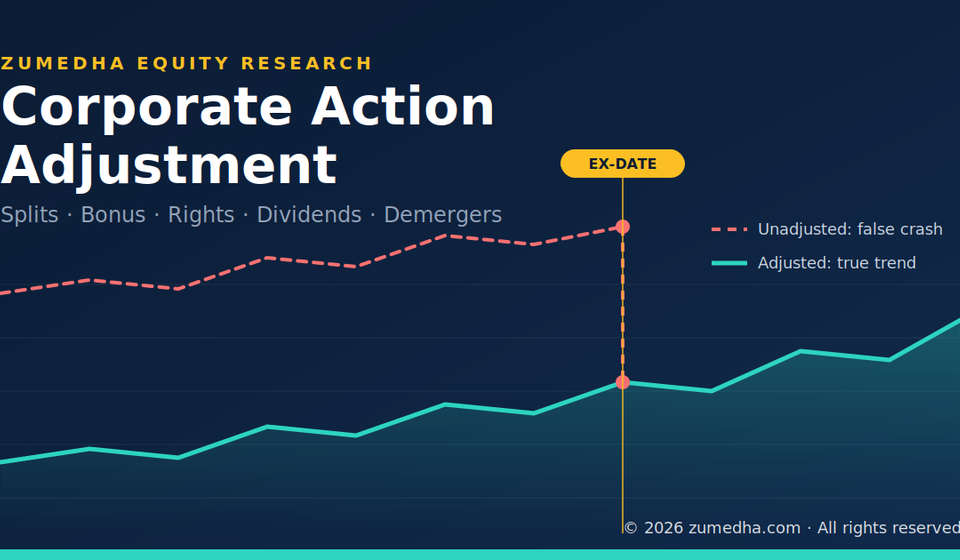
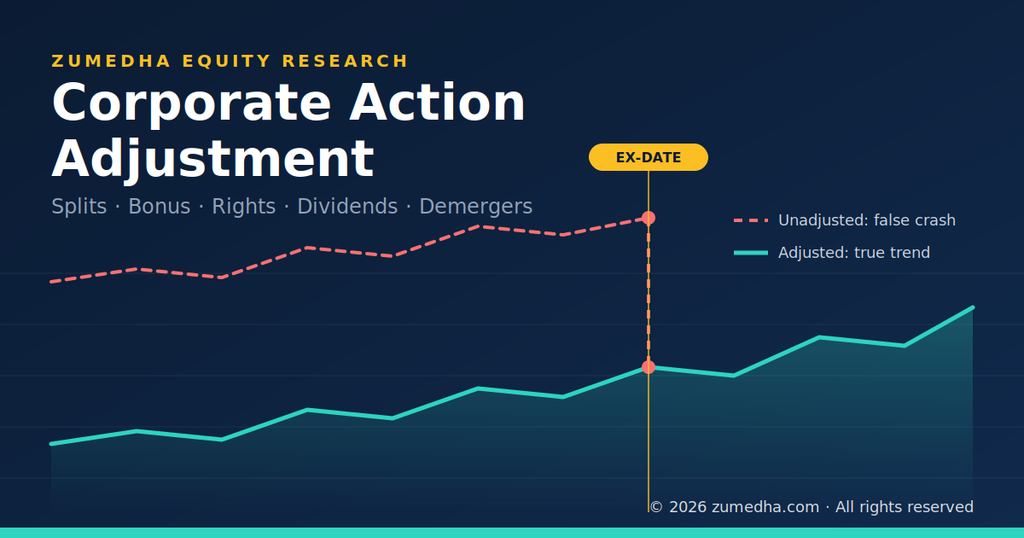
Pull up a ten-year price chart of any long-listed Indian company and you will notice something odd if the data is wrong: a sudden 50% “crash” overnight, a volume spike that makes no sense, or an EPS series that jumps around for no business reason. In most cases nothing dramatic happened to the business. The company simply did a corporate action, and the historical data was not adjusted for it.
Corporate action adjustment is the process of restating historical prices, volumes, per-share financials and valuation multiples so that they remain comparable across time after the company changes its share structure or distributes value to shareholders.
Getting this wrong quietly corrupts everything built on top of it: return calculations, moving averages, backtests, P/E and P/B history, DCF per-share values, and dividend yield. At Zumedha, adjusting for corporate actions is a baseline step before any valuation is published, and this article explains exactly how it works.
What Is a Corporate Action?
A corporate action is an event initiated by a company that changes its capital structure, share count, or the value attributable to each share. In India these are announced via exchange filings on NSE and BSE under SEBI’s LODR (Listing Obligations and Disclosure Requirements) framework, along with a record date and an ex-date.
They fall into two broad groups:
- Actions that change the share count or price level without changing the company’s value: stock splits, bonus issues, consolidation (reverse split).
- Actions that move value between the company and shareholders, or between entities: cash dividends, rights issues, buybacks, mergers, demergers, spin-offs.
The adjustment method differs for each group, and that is where most errors creep in.
Key Terms You Must Know
- Record date: the cut-off date on which your name must be on the company’s register to be eligible for the benefit.
- Ex-date (ex-entitlement date): the first trading day on which the stock trades without the entitlement. In India’s T+1 settlement cycle, the ex-date is generally the same as the record date, so a buyer on or after this date does not receive the benefit.
- Cum-price: the price before the ex-date, which includes the entitlement.
- Adjustment factor: a multiplier applied to all historical prices before the ex-date.
- Back-adjustment: the standard approach where old data is changed to match the current share structure, leaving recent data untouched.
Method 1: Stock Split
In a split, a share of higher face value is divided into shares of lower face value. A 1:5 split of a ₹10 share, for instance, becomes five shares of ₹2 each. The market capitalisation stays the same; the price per share falls and the number of shares rises.
Adjustment factor for prices:
Price adjustment factor = 1 / (split ratio)
Adjustment factor for volume and share counts:
Volume adjustment factor = split ratio
Worked example: XYZ Ltd (hypothetical) trades at ₹2,000 on the day before a 1:5 split (one share becomes five). On the ex-date it opens near ₹400.
- Every historical close before the ex-date is multiplied by 1/5 = 0.20. A close of ₹1,800 last year becomes ₹360.
- Every historical volume before the ex-date is multiplied by 5.
- Historical EPS, DPS and book value per share are divided by 5.
- Shares outstanding are multiplied by 5.
Without this, the chart would show a fake 80% crash on the ex-date.
Method 2: Bonus Issue
A bonus issue distributes free additional shares out of reserves. It is expressed as B:A, meaning B new shares for every A shares held. A 1:1 bonus gives one free share for each one held; a 2:1 bonus gives two free shares for each one held (be careful, since some announcements phrase the ratio the other way round).
Adjustment factor for prices:
Price adjustment factor = A / (A + B)
Worked example: XYZ Ltd announces a 1:1 bonus (A = 1, B = 1). Factor = 1 / (1 + 1) = 0.50.
- Pre-ex-date prices are halved.
- Pre-ex-date volumes are doubled.
- Per-share metrics (EPS, BVPS, DPS) are halved.
- Shares outstanding double.
Mathematically a bonus issue behaves like a split for adjustment purposes, but it differs in accounting: reserves are capitalised into share capital, and the face value per share stays the same. Always read the announcement to confirm whether the action is a split, a bonus, or both together. Some companies announce a split and a bonus back to back, and the factors multiply.
Method 3: Rights Issue
A rights issue offers existing shareholders the right to buy new shares, usually at a discount, in a stated ratio. Unlike splits and bonuses, new money comes into the company, so the theoretical value per share changes.
Step 1: Compute the Theoretical Ex-Rights Price (TERP):
TERP = (N × P_cum + n × P_rights) / (N + n)
where N is the number of existing shares in the ratio, n is the number of new shares offered, P_cum is the cum-rights closing price, and P_rights is the issue price.
Step 2: Compute the adjustment factor:
Adjustment factor = TERP / P_cum
Worked example: XYZ Ltd offers a rights issue in the ratio 1 new share for every 4 held, at ₹300. The cum-rights price is ₹500.
- TERP = (4 × 500 + 1 × 300) / 5 = 2,300 / 5 = ₹460
- Adjustment factor = 460 / 500 = 0.92
All prior prices are multiplied by 0.92. Note that the factor is close to, but not equal to, 1, because the discount on the new shares dilutes value slightly. The deeper the discount, the larger the adjustment.
Do the share-count adjustment too. For per-share fundamentals, rights issues are best handled by adjusting prior-period EPS with the same factor, a convention consistent with accounting standards on earnings per share (Ind AS 33), which requires retrospective adjustment for the bonus element of a rights issue.
Method 4: Cash Dividends
Dividends are the most debated adjustment. There are two schools:
- Price-only (unadjusted for dividends): prices reflect actual traded values. Most Indian charting platforms and exchange data default to this for dividends, adjusting only for splits, bonuses and rights.
- Total-return (dividend-adjusted): historical prices are reduced to reflect dividends paid, so that percentage changes represent total shareholder return.
Dividend adjustment factor (proportional method):
Factor = 1 − (Dividend / Previous close before ex-date)
Worked example: XYZ Ltd pays a ₹20 dividend; the close before the ex-date is ₹1,000. Factor = 1 − 20/1000 = 0.98. All earlier prices are multiplied by 0.98.
Which should you use? If you are measuring long-term investor returns, use total return (or add dividends back explicitly). If you are studying price levels, support and resistance, or valuation multiples at the time, use price-only. The key is to never mix the two in one calculation.
Method 5: Buybacks
In a buyback, the company repurchases its own shares, either through a tender offer or open market route. There is no price adjustment for a buyback in standard practice, since the price is not mechanically altered on a specific ex-date in the way splits and bonuses are. What changes is the shares outstanding, which affects:
- EPS going forward (higher, other things equal)
- Book value per share
- Market capitalisation and per-share intrinsic value in a DCF
For valuation work, always use the latest diluted share count, adjusted for completed buybacks.
Method 6: Mergers and Amalgamations
In a merger, shareholders of the merging company receive shares of the acquirer per an exchange ratio approved in the NCLT scheme. For the acquirer, history generally is not price-adjusted, but its financials after the effective date include the merged entity. For the target, the stock is delisted and its history ends.
The analytical traps here:
- Pro forma financials. Revenue and profit growth across the merger date are inflated by the acquisition, not by organic growth. Compare using pro forma or restated numbers where the company provides them.
- Share count jump. New shares issued to the target’s holders raise the share count, diluting per-share metrics.
- Appointed date vs effective date. Schemes often apply from a past appointed date, which can mean prior-period numbers are restated retrospectively in the company’s own filings.
Method 7: Demergers and Spin-offs
In a demerger, one business is separated into a new listed entity, and shareholders receive shares of the new company in a stated ratio. The parent’s price drops on the ex-date by roughly the value of the demerged business per share.
Adjusting the parent’s history requires a cost allocation ratio, which is usually disclosed in the scheme document and by the company on the basis of the net worth or fair value split:
Adjustment factor = 1 − (Cost of acquisition allocated to the demerged entity %)
Worked example: XYZ Ltd demerges its retail arm. The company discloses that 15% of the cost of acquisition of XYZ shares is allocated to the new entity. The factor for the parent is 0.85, so pre-demerger parent prices are multiplied by 0.85, and the new entity’s price history starts on its listing date. Exchanges also often conduct a special pre-open session to discover the price of the parent on the ex-date.
Because the company’s own cost allocation drives the factor, different data vendors can differ here. Always check against the filing.
What Else Gets Adjusted?
Prices are only the visible part. A proper adjustment cascade covers:
- Historical volume: inverse of the price factor.
- EPS and diluted EPS: divided by the cumulative share multiplier, as required by Ind AS 33 for bonus and split.
- Book value per share and DPS: same treatment.
- Shares outstanding and market cap history: shares scaled up; market cap should stay continuous across a pure split or bonus.
- Valuation multiples: P/E and P/B should be recomputed from adjusted prices and adjusted per-share data. If both are adjusted correctly, the multiple is unchanged by a split or bonus.
- Moving averages, RSI, Bollinger Bands, and other indicators: recompute from adjusted prices; do not adjust the indicator values themselves.
- Options and futures: NSE adjusts strike prices and lot sizes for corporate actions on derivatives contracts, so check the exchange circular if you trade F&O.
- Target prices and stop-losses: your own price levels set before the action need conversion too.
Putting Multiple Actions Together
When a stock has several actions over time, build a cumulative adjustment factor by multiplying the individual factors from the latest event backwards:
Adjusted price(t) = Raw price(t) × (product of all factors for events with ex-date after t)
Example: a stock had a 1:1 bonus in 2019 (factor 0.5), a 1:5 split in 2022 (factor 0.2), and a rights issue in 2024 (factor 0.95).
- A price in 2018 is multiplied by 0.5 × 0.2 × 0.95 = 0.095
- A price in 2021 is multiplied by 0.2 × 0.95 = 0.19
- A price in 2023 is multiplied by 0.95
- Prices after the 2024 ex-date are unchanged
A Simple Python Implementation
For analysts who maintain their own price database, here is a clean pattern using pandas:
import pandas as pd

# prices: DataFrame indexed by date with a 'close' column (raw prices)
# actions: DataFrame with columns ['ex_date', 'factor'] (price factor per event)

def adjust_prices(prices, actions):
    adj = prices.copy()
    adj['cum_factor'] = 1.0
    for _, row in actions.sort_values('ex_date').iterrows():
        # Apply factor to all dates strictly before ex-date
        mask = adj.index < row['ex_date']
        adj.loc[mask, 'cum_factor'] *= row['factor']
    adj['adj_close'] = adj['close'] * adj['cum_factor']
    return adj

# Example events
actions = pd.DataFrame({
    'ex_date': pd.to_datetime(['2019-08-01', '2022-03-15', '2024-06-10']),
    'factor':  [0.5, 0.2, 0.95]
})
Volume is adjusted by dividing by the same cumulative factor (for split and bonus events).
Common Mistakes to Avoid
- Using the announcement date instead of the ex-date. Adjustments start from the ex-date, not when the news broke.
- Confusing bonus ratio direction. “1:2 bonus” can mean one bonus share for two held, which is a very different factor from two for one. Always read the exchange notice.
- Forgetting to adjust EPS and book value after adjusting price, which produces a distorted P/E and P/B history.
- Mixing adjusted and unadjusted data from different sources in a single model.
- Ignoring face value changes. A split changes face value; a bonus does not. Use the exchange filing to confirm which one applies.
- Skipping demerger adjustments, which leaves a false price drop on the parent’s chart.
- Double adjusting data that your vendor has already adjusted. Check whether your source is raw or adjusted before you apply factors.
- Applying dividend adjustment to price levels used for valuation comparison, which makes historical valuation multiples look lower than they actually were.
Why It Matters for Valuation
Valuation is a per-share exercise at the end of the day. Whether you use a DCF, relative valuation, NAV or EPV, the final step divides an equity value by a share count, and that share count must reflect all completed corporate actions.
- A DCF that arrives at an equity value of ₹50,000 crore divided by a pre-bonus share count will give a per-share value twice as high as one divided by the post-bonus count. The company is worth the same, but the per-share answer is wrong by 2x.
- Historical P/E bands used for relative valuation are only meaningful when EPS and price are adjusted on the same basis.
- Dividend yield calculations must use a DPS adjusted for splits and bonuses, or the yield history will have false breaks.
- Return on equity and per-share growth rates (EPS CAGR, DPS CAGR) can be badly overstated or understated if different periods use different share bases.
Impact on the Cash Market and F&O
The same corporate action hits the two segments differently. In the cash market, the price and your entitlement change. In futures and options, the contract terms (strike, lot size, futures base price) change so that your position keeps the same value.
Cash market
- Price: on the ex-date the stock opens at an adjusted reference price. A 1:1 bonus roughly halves it, a split cuts it by the split ratio, and a rights issue lowers it by a smaller TERP-based amount. Your holding value is unchanged; only the share count and price per share differ.
- Entitlement: you must be on the register on the record date to receive bonus shares, split shares, rights or a dividend. A buyer on or after the ex-date does not receive them.
- Charts and screeners: unadjusted data shows a false gap on the ex-date, which is why back-adjustment matters.
- Circuit limits and pending orders: price bands follow the adjusted reference price, so limit orders and stop-losses set at old prices need to be re-placed.
- Demergers: the parent’s price is discovered on the ex-date, often through a special pre-open session, and the new entity lists separately later.
Futures and options
The exchange’s stated principle is that the value of a participant’s position on the cum and ex-dates should stay the same as far as possible. The adjustment can change the futures base price, the market lot and the option strike values.
- Bonus and split options: new strike = old strike ÷ adjustment factor; new lot = old lot × adjustment factor.
- Bonus and split futures: new base price = old futures price ÷ adjustment factor; new lot = old lot × adjustment factor.
- Rights issues: NSE circulars apply a TERP-based factor below 1 in the opposite direction: strike and futures price are multiplied by the factor and the lot is divided by it.
- No entitlement: holders of F&O contracts do not receive the bonus, split shares, rights or dividend. To receive them you must hold the shares in the cash market through the record date.
- Rounding: adjusted strikes and futures prices are rounded to the nearest tick size and lot sizes to the nearest integer, so a small residual difference in position value is possible.
- Orders: because lot sizes change, after-market orders placed before the ex-date may be rejected.
- Dividends: not every dividend triggers an F&O adjustment. NSE has issued dividend adjustment circulars (for example for ITC’s ₹8 dividend with a 27 May 2026 ex-date), but the criteria come from SEBI and NSE rules, so check the circular for each case.
Worked examples from NSE circulars
| Security | Action | Adjustment factor | Strike example | Lot size |
|---|---|---|---|---|
| LICI | Bonus, ex-date 29 May 2026 | 2 | 820 CE becomes 410 | 700 to 1,400 |
| Trent | Bonus, ex-date 4 Jun 2026 | 1.5 | 4150 CE becomes 2,766.67 | 100 to 150 |
| MCX | Split, ex-date 2 Jan 2026 | 5 | Revised per NSE annexure | Revised to 625 |
Note the ratio convention: in the LICI and Trent circulars the factor for an A:B bonus is (A+B)/B, so 1:1 gives 2 and 1:2 gives 1.5. This is the inverse of the price factor used for historical cash data earlier in this article (0.5 and 0.667). Same event, opposite way of writing the number, so always check which convention a source uses.
Practical points for F&O traders
- Read the NSE F&O circular for each action: it gives the factor, revised lot size and revised strikes.
- A revised strike scheme can take effect from the trading day after the ex-date, which may change which strikes are available.
- Margins, quantity freeze limits and position sizing change with the lot size.
- Adjusted strikes can be odd numbers (like 2,766.67), and such contracts can be illiquid for a while.
- Rules and thresholds are revised from time to time, so verify against the latest NSE and SEBI circulars before trading.
Sources: NSE F&O circulars NSE/FAOP/74446 (LICI bonus), NSE/FAOP/72114 (MCX split) and NSE/FAOP/74365 (ITC dividend); Trent bonus F&O adjustment explainer.
Practical Checklist for Investors and Analysts
Before relying on any long-term chart, ratio history, or valuation model, run through this list:
- Pulled the full corporate action history from the exchange or company filings (NSE and BSE corporate action pages, annual report notes)
- Confirmed ex-dates and ratios for each split, bonus, rights issue, and demerger
- Identified whether the data source is raw or already adjusted
- Applied cumulative adjustment factors to price and inverse factors to volume
- Restated EPS, DPS and BVPS to a consistent share base
- Recomputed valuation multiples from adjusted inputs
- Used the latest diluted share count for per-share intrinsic value
- Decided on and documented price-only versus total-return treatment of dividends
- Cross-checked a few data points against a second source
Frequently Asked Questions
Does a stock split create value for shareholders? No. Total holding value is unchanged. A split improves liquidity and accessibility for small investors, but it is not a change in fundamentals.
Is a bonus issue the same as a dividend? No. A dividend is cash paid out. A bonus issue is a capitalisation of reserves into additional shares; no cash leaves the company and no value is created by itself.
Why does the stock price fall on the ex-dividend date? Because the cash has left the company’s value and now belongs to shareholders who held on the record date. The price drop is approximately equal to the dividend, subject to market movement on the day.
Do I need to adjust data for buybacks? Not the price history in the standard approach. You do need to update the share count for per-share calculations.
Why do two data vendors show different adjusted prices for the same stock? Usually because of different treatment of dividends, rights issue TERP methodology, or demerger cost allocation. Know your source’s method before comparing.
Do I need to adjust my stop-loss or target after a split? Yes. Convert your own levels using the same factor, or your orders will sit at meaningless prices.
Key Takeaways
- Corporate action adjustment keeps historical data comparable with the current share structure.
- Splits and bonuses use simple ratio-based factors; rights issues use TERP; demergers use a disclosed cost allocation ratio; dividends depend on whether you want price-only or total-return series.
- Adjust price, volume, EPS, DPS, book value, and share count together, never just price.
- Mixing adjusted and unadjusted data is one of the most common and most silent errors in equity analysis.
- Always verify against exchange filings and company disclosures rather than trusting a single data source.
At Zumedha Equity Research, corporate action checks are part of the standard data hygiene before every report, because a valuation is only as reliable as the per-share numbers that sit under it.
Disclaimer: This article is for educational purposes only and does not constitute investment advice or a recommendation to buy or sell any security. Examples use a hypothetical company (XYZ Ltd) for illustration. Exchange rules, settlement cycles, and accounting standards can change, so please verify current requirements with NSE, BSE, SEBI and the company’s official filings before acting on any of the information above.
