










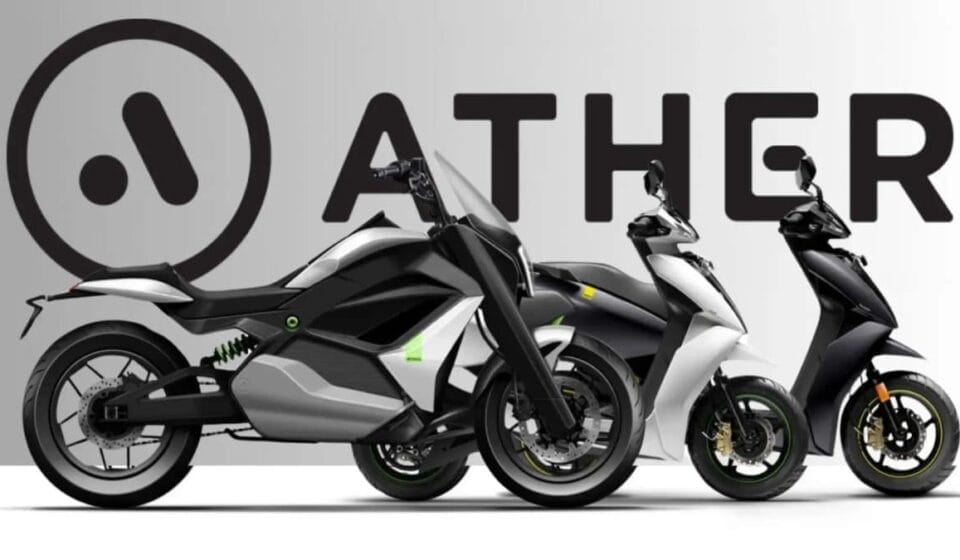
Ather Energy DCF Valuation and Share Price Analysis Aug 2026
Ather Energy Limited
A pioneer betting its lead on Factory 3.0
Ather Energy, founded in Bengaluru in 2013 by Tarun Mehta and Swapnil Jain, designs and manufactures smart electric scooters and operates one of India’s largest dedicated fast-charging networks. The company listed on the NSE and BSE in May 2025 at an issue price of ₹321, raising ₹2,626 crore through a fresh issue alongside an offer for sale.
The product portfolio spans two distinct lines: the performance-oriented Ather 450 series (450X, 450S, 450 Apex) aimed at younger, urban riders, and the Rizta family scooter launched in 2024, which has broadened Ather’s addressable base into Tier-2/3 markets such as Gujarat, Odisha, Rajasthan and Himachal Pradesh. Non-vehicle revenue — AtherStack Pro software subscriptions (94% attach rate), the Ather Grid/LECCS charging network, accessories and service — contributed roughly 14% of operating revenue in Q1 FY27, a genuine and improving diversification away from pure hardware margins.
Distribution has scaled sharply: 700 Experience Centres (up from 351 a year earlier) and ~548 service centres as of FY26, supported by over 6,000 fast-charging points across 395+ cities — the largest such network for two-wheelers in India. Hero MotoCorp, an early strategic investor since 2016, remains Ather’s largest shareholder at ~29.5% and has committed a further ₹1,000 crore preferential investment, underscoring both financial support and a degree of strategic alignment with India’s largest two-wheeler maker.
Loss narrowing sharply as scale kicks in
Ather’s income statement tells a clean operating-leverage story: revenue has roughly tripled over three years while the loss margin has compressed from over 30% of revenue to low single digits, culminating in the company’s maiden EBITDA-positive quarter in Q1 FY27.
| Particulars (₹ Cr) | FY24 | FY25 | FY26 | Q1 FY26 | Q1 FY27 |
|---|---|---|---|---|---|
| Revenue from Operations | 1,780 | 2,255 | 3,672 | 645 | 1,217 |
| Total Income | 1,844 | 2,305 | 3,823 | 673 | 1,260 |
| EBITDA | (499) | (509) | (~330) | (106) | 9 |
| EBITDA Margin | (28.0%) | (22.6%) | (9.0%) | (16.4%) | 0.8% |
| Net Loss | (1,059) | (812) | (517) | (178) | (51) |
| Deliveries (units) | 1,09,577 | 1,55,691 | 2,62,942 | 46,090 | 83,173 |
FY24/FY25 EBITDA are analyst estimates built from disclosed EBIT/loss-before-tax bridges; FY26 EBITDA is a full-year approximation derived from quarterly disclosures. Figures are consolidated unless stated.
Discounted cash flow: the model says the stock is priced well ahead of fundamentals
We project a 10-year explicit FCFF build (WACC 12%, terminal growth 5%), reflecting a business still capacity-constrained today but with a credible multi-year path to double-digit EBITDA margins as Factory 3.0 ramps, non-vehicle revenue scales, and the EV two-wheeler category matures toward the 25–30% penetration levels seen in mature EV markets.
10-Year FCFF Build (₹ Crore)
| Year | Revenue | EBITDA % | EBIT | NOPAT | Capex | FCFF | PV @ 12% |
|---|---|---|---|---|---|---|---|
| FY27E | 6,058 | (2.0%) | (394) | (394) | 545 | (690) | (617) |
| FY28E | 9,693 | 3.0% | (145) | (145) | 824 | (570) | (454) |
| FY29E | 14,055 | 7.0% | 422 | 316 | 984 | (140) | (100) |
| FY30E | 18,975 | 10.0% | 1,233 | 925 | 1,044 | 511 | 325 |
| FY31E | 23,719 | 12.0% | 2,087 | 1,565 | 1,067 | 1,229 | 697 |
| FY32E | 28,462 | 13.0% | 2,846 | 2,135 | 1,139 | 1,826 | 925 |
| FY33E | 32,732 | 14.0% | 3,666 | 2,749 | 1,146 | 2,499 | 1,130 |
| FY34E | 36,005 | 14.5% | 4,285 | 3,214 | 1,080 | 3,056 | 1,235 |
| FY35E | 38,525 | 15.0% | 4,816 | 3,612 | 1,079 | 3,486 | 1,257 |
| FY36E | 40,451 | 15.0% | 5,097 | 3,823 | 1,011 | 3,776 | 1,216 |
Sensitivity (₹/share) — WACC vs. terminal growth:
| WACC \ Terminal g | 4.0% | 4.5% | 5.0% | 5.5% | 6.0% |
|---|---|---|---|---|---|
| 10% | 849 | 913 | 989 | 1,082 | 1,198 |
| 11% | 693 | 736 | 785 | 843 | 913 |
| 12% (base) | 578 | 608 | 641 | 680 | 726 |
| 13% | 490 | 511 | 535 | 563 | 594 |
| 14% | 420 | 436 | 454 | 474 | 496 |
Even at the most generous end of our sensitivity grid (10% WACC, 6% terminal growth), DCF fair value tops out around ₹1,200 — still below the current market price of ₹1,450. The market is pricing in either a faster margin ramp, a longer high-growth runway, or a lower cost of capital than our base assumptions allow; investors should treat the current price as a bet on flawless execution of Factory 3.0 and continued EV category share gains, not as a valuation supported by discounted cash flows alone.
No clean comp — Ather sits between a loss-making pure-EV peer and profitable diversified two-wheeler majors
Ather’s closest business-model peer, Ola Electric, is loss-making and in retreat (FY26 revenue nearly halved, market share ceded to single digits in several months of 2026). TVS Motor, Bajaj Auto and Hero MotoCorp run profitable EV businesses inside large, cash-generative ICE franchises, making like-for-like P/E comparison meaningless — we instead frame Ather against EV/Sales, since earnings are not yet representative.
| Company | Mkt Cap (₹ Cr) | TTM Revenue (₹ Cr) | EV/Sales (x) | P/B (x) | EV Market Share* |
|---|---|---|---|---|---|
| Ather Energy | ~56,900 | ~4,244 | ~13.2x | ~21.6x | ~17% |
| Ola Electric | ~19,190 | ~2,245 (auto) | ~8.5x | NM | ~7–10% |
| TVS Motor (consol.) | ~1,00,000+ | ~45,000+ | ~2.2x | ~13x | ~24–25% (leader) |
| Bajaj Auto (consol.) | ~2,30,000+ | ~52,000+ | ~4.4x | ~7x | ~22% |
*EV market share figures move materially month-to-month depending on the data source (Vahan retail vs. FADA vs. company-reported wholesale). TVS/Bajaj EV/Sales and P/B are blended across their full ICE+EV business and are not directly comparable to Ather’s pure-EV multiples; they are shown for context only.
On a pure EV/Sales basis, Ather trades at roughly 1.5x Ola Electric’s multiple despite comparable near-term growth uncertainty, reflecting the market’s preference for Ather’s cleaner execution, positive EBITDA inflection, and Hero MotoCorp’s balance-sheet backing. Against diversified majors trading at single-digit EV/Sales on profitable, cash-generative businesses, Ather’s premium is entirely a bet on the EV category continuing to take share from ICE two-wheelers faster than the incumbents can defend it.
Book value offers little valuation support
Total equity stood at ₹2,572.63 crore as of March 31, 2026 (up from ₹493 crore a year earlier, largely IPO proceeds), against total assets of ₹4,721.51 crore. On ~38.3 crore shares outstanding, book value works out to roughly ₹67/share — the stock trades at over 21x book, meaning the asset-based approach is not a meaningful floor for this business. Ather’s real value lies in brand, technology stack (BMS, AtherStack software), distribution network and the charging moat — intangible assets that accounting book value does not capture, but which a pure NAV approach cannot credit either.
Not yet applicable — EPV requires sustainable current earnings
EPV capitalises a normalised current EBIT under a no-growth assumption — a technique built for stable, profitable businesses. Ather turned EBIT-positive for the first time only in a partial sense (EBITDA of ₹9 crore in Q1 FY27, EBIT still negative after depreciation). With normalised earnings not yet established and capacity still expanding rapidly, an EPV read at this stage would understate the business meaningfully and is not a reliable input to the verdict. We flag this explicitly rather than force a number: EPV becomes a genuinely useful cross-check only once Ather has 4–6 quarters of stable, capacity-unconstrained EBIT.
N/A — single-segment pure-play
Ather reports and operates as a single electric two-wheeler business (vehicles plus an adjacent, still-small non-vehicle software/charging/services layer that is not separately disclosed with segment-level profitability). SOTP is not applicable; the DCF and relative valuation approaches carry the weight of this analysis.
Entry zones anchored to DCF and technical support
What has to go right
Zones to trim or exit
What would break the thesis
Growth levers are real, but capacity has been the binding constraint
- Factory 3.0 (AURIC, Maharashtra): Phase 1 (5 lakh units/year) due online Q3 FY27, directly addressing the capacity ceiling that has left an estimated 13,000–15,000 units/month of unmet retail demand at Hosur.
- EL platform: New scooter platform unveiling August 29, 2026, targeted at a broader, less-affluent customer base — the company’s first real push down-market beyond the Rizta.
- Non-vehicle revenue: Software (AtherStack Pro, 94% attach rate), charging network monetisation and services — currently ~14% of revenue, with structurally higher margins than hardware.
- Category tailwind: EV two-wheeler penetration crossed 10% of overall industry sales for the first time in June 2026 and continues to climb; Ather, TVS, Bajaj and Hero together captured ~96% of the industry’s incremental H1 2026 registrations.
- Fresh capital: ₹2,500 crore raised in Q1 FY27 (QIP), plus Hero MotoCorp’s proposed additional ₹1,000 crore investment, funds Phase 2 expansion optionality without near-term equity dilution risk from a cash crunch.
Balancing a strong operating inflection against a demanding valuation
Bull Case Drivers
- First EBITDA-positive quarter (Q1 FY27) validates the operating-leverage thesis
- Demand consistently outstripping supply — a rare, enviable problem
- Hero MotoCorp’s growing financial and strategic backing
- Largest dedicated two-wheeler fast-charging network in India, a genuine moat
- EV category penetration still has significant runway from ~10% today
Bear Case Risks
- Valuation is priced for a near-flawless multi-year execution path — DCF suggests 20–55% downside even in generous scenarios
- Factory 3.0 execution risk; any slippage directly caps volume growth
- Commodity cost headwinds (battery materials) pressuring gross margin, partially offset by price hikes
- Intensifying competition from well-capitalised, profitable ICE majors (TVS, Bajaj, Hero) entering EVs at scale
- Still pre-profitability at the PAT level; net loss narrowing but not yet eliminated
Verdict
Ather Energy’s operating story has turned a genuine corner — revenue growth approaching 90% YoY, the first EBITDA-positive quarter, a rapidly improving loss trajectory, and a demand backdrop where the constraint is supply, not sales. Factory 3.0’s Q3 FY27 ramp and the upcoming EL platform launch are credible, near-term catalysts. Weighing this operating momentum against our DCF (base-case fair value ≈₹640, bull-case ceiling near ₹1,200) and a relative-valuation picture that shows Ather trading well above both its pure-EV peer and diversified ICE majors on EV/Sales, this analysis suggests the current price already discounts a highly favourable multi-year outcome. We view Ather as a Hold for existing holders and an Accumulate-on-dips candidate for new investors with a 12–18 month horizon and a high tolerance for valuation risk, rather than a fresh buy at current levels.